
 Not really - theoretically we still have lots of garden time left here, but there are now less than two weeks before it's time to go back and "reinvent the wheel" as a new school year begins. Certain plants always help to lighten the gathering doom and gloom that I feel as my schedule begin to fill up again after a pretty good month of unstructured time (and unlimited access to a bathroom!) Crinums, along with their diminuitive cousins, the Zephyranthes and Habranthus (collectively known as "rain lilies") are chief among these. Above is C. bulbispermum, the hardiest of species and most prolific in terms of seed production. I've probably shown it before, but it produces blooms all spring and summer, so more than bears repeating. It's in the background of many of the hardier hybrids, but none of them, in my experience, has inherited its beautiful, glaucous foliage. To the left are the buds of C. 'Bradley' - more on this hybrid later.
As time goes on I find myself filling more and more garden space with members of the Amaryllis tribe - beginning in early spring (actually late fall, but that's another article) with the Galanthus, Leucojum, and Narcissus, and continuing long into fall as the Sternbergias, Lycoris, and Amarcrinums bloom, they are among the most dependable bulbs for our climate. One reason for this is the fact that they are distasteful (poisonous, according to many sources) to rodents, and voles are a huge problem here. Another is that, in most cases, they tolerate the periodic summer inundation and drying out that our soils experience. Whereas tulips are basically annuals here, Crinums are a lifetime investment.
 I won't go into all of the info on this family, since everything I know has been collected from books, nursery catalogs and websites. One of the best books on the subject (and one of my top five favorite gardening books, period) is "Garden Bulbs for the South" by Scott Ogden. I owned the first edition, and liked it so much that I replaced when the second edition was published a couple of years ago. "Bulbs for Warm Climates" by Thad M. Howard, is another great source of information on the subject, as are numerous websites, notably one hosted by Jenks Farmer, who once served as director of the Riverbanks Botanical Garden in Columbia, SC, and another detailing the work of Marcel Sheppard, a noted crinum breeder. It's amazing how much information is available now on what was a relatively unknown genus when I started collecting the various species and hybrids several years ago. Here are a few examples of Crinums which have done well in our garden over the years.
 Don't panic - this is not a picture from the website of the dreaded TyTy Nursery in Georgia; just reading the scathing reviews of this establishment on the many newsgroups is enough to send one screaming into the night. I have to say that my one experience in ordering from them resulted in what has become a huge clump of C. scabrum - luckily I only ordered the one bulb, because it arrived unlabled and rolling around in a box. Actually, this is my favorite roommate, Ron, posing (under duress) with my favorite Crinum (and not just because Scott Ogden says that it should be), a hybrid called 'Emma Jones'. Ron's 5'11" when he stands up straight, so it's obvious that this plant is a whopper. About 10 years old, it has over a dozen scapes in evidence now, and will continue to produce them sporadically until frost knocks it down. They smell amazing, and if you take a few minutes to stake them, they open right at nose level. Here's a better view of the open flowers:
  When I started collecting Crinums, they were all but unavailable, and the best way to get them was by knocking on doors in the country (generally homes which harbor old clumps of Crinum don't have doorbells) and begging. Since this is unpalatable to intrinsically shy people (and mortifying to their traveling companions), the internet has been a great boon as the popularity of the genus has grown. Ebay, in particular, can be a good source of material, but only for those armed with some knowledge ahead of time. There are some sellers who've really done their homework and take pains to make sure that their plants are accurately labeled, and then there are those who dig up bulbs out of their yards, arbitrarily name them after their grandchildren or their chihuahas, and list them for sale. Some mainstream nurseries are carrying crinums as well, and their catalogs can be good sources of information and illustrations, even if the bulbs are actually purchased from a less expensive source (don't tell Tony Avent I wrote that...)
 The above plant is one that I literally inherited from my Grandmother Joyner - it grew in a solid mass along the foundation of her house, and had done so for at least 30 years when I got it in 1993. To the best of my knowledge, it's one of the bulbispermum x americanum hybrids, either "Carolina Beauty" or "Miss Elsie". Anyway, it's completely hardy, blooms early and repeats sporadically, and multiplies in wet or dryish soil. I also grow a related hybrid, 'Ollene', which performs similarly. Below is a representative of the xherbertii grex, very commonly seen as huge, isolated clumps growing in trailer parks and in front of run-down country shacks; all the members of this group share C. bulbispermum x scabrum parentage.
 Speaking of clumps in front of shacks, that's where the healthiest, most productive clumps of crinum seems to grow. Many of mine are too hemmed in by other plants, so they don't have the elbow room they need to grow into specimens such as my neighbor Jane's spectacular C. powellii album - it's taller, and much broader than she is by far, and had several dozen scapes open last month, when I should have taken their picture together. If she ever moves, or gets tired of it, I may plant that variety, but as it is, I don't have to!
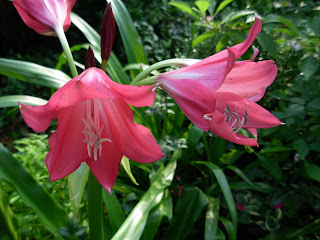 Above is 'Ellen Bosanquet', the most common of the "reds", and below is one of its taller, slightly darker (although that's not apparent in this photo, due to exposure), progeny, "Elizabeth Traub",blooming in front of Canna 'Australia'.
  I recently splurged on a bulb of 'Lorraine Clark', reportedly the deepest red hybrid available - nothing to report yet regarding its performance here.
Speaking of Australia, here's one that was hybridized there - 'Bradley'. It's nearly as dark as 'Ellen' and 'Elizabeth', but smaller in texture throughout. It's also pictured (in bud) at the very beginning of this post.
 I featured C. 'Carnival' in a post from earlier this summer, but the current blooms are showing a lot more of this hybrid's characteristic striping, perhaps due to the warmer nights we've been having lately.
 C. 'White Prince', a hybrid of C. album (aka yemense) x moorei.
 And C. moorei itself, showing the interesting, balloon-shaped bud form. In general this whole branch of the family - mostly late-blooming white hybrids, such as 'St. Christopher', has been less successful for me. They return well, but tend to multiply vegetatively at the expense of bloom. When they do bloom, they are attractive, but need protection from direct sun (hence the browning of the bud tips apparent in the photo).
 A big clump of 'Walter Flory', growing happily next to our dilapidated back fence - I told you they prefer trashy locations!
 C. americanum, which prefers boggy conditions and is nearly indistinguishable from C. erubescens, which does well in a drier location.
 Here's C. erubescens:
Below is an unusually diminuitive (only 8" high at most, but spreading to 2' in diameter so far) member of this group, C. oliganthemum from the West Indies. It needs lots of heat and water to produce its blooms, but makes an attractive ground cover even without them. I've toyed with hybridizing this one, crossing it successfully (I think) with both Emma Jones and C. procerum 'Splendens'; no blooms yet from either, and neither has been risked outside in winter yet. I've since seen the latter cross available commercially as C. 'Menehune', so it will be interesting to see how mine turn out. While the cross with 'Emma' should increase the chances of hardiness, procerum is as iffy here as oliganthemum, so I'll be cautious in testing that one. 
 Here's C. procerum 'Splendens', I think. The nomenclature and parentage of this bunch of probable hybrids (C. asiaticum figures somewhere in the mix) is so confused that writers far more savvy than I seem to be unable to unravel the mess. At any rate, this is an older picture - this particular plant now towers over me, especially when it sends up its huge, purple spikes of bloom. It now lives permanently in the greenhouse, since it's way too heavy for me to haul it in and out anymore, especially at my advanced age! It's the plant that lends the deep red coloration to the foliage of C. 'Sangria' (whose other parent, bulbispermum, contributes cold hardiness and reduces its size considerably), which I've shown in previous entries. I have another plant, almost as large, which is similar, but doesn't exhibit the same amount of anthocyanin as this. The progeny of both of these "tree crinums", so called because they really do develop a trunk-like structure (really the neck of the bulb) over time, are planted out in the garden, and so far have returned in spring, but haven't bloomed.
 Here's C. procerum 'Splendens', I think. The nomenclature and parentage of this bunch of probable hybrids (C. asiaticum figures somewhere in the mix) is so confused that writers far more savvy than I seem to be unable to unravel the mess. At any rate, this is an older picture - this particular plant now towers over me, especially when it sends up its huge, purple spikes of bloom. It now lives permanently in the greenhouse, since it's way too heavy for me to haul it in and out anymore, especially at my advanced age! It's the plant that lends the deep red coloration to the foliage of C. 'Sangria' (whose other parent, bulbispermum, contributes cold hardiness and reduces its size considerably), which I've shown in previous entries. I have another plant, almost as large, which is similar, but doesn't exhibit the same amount of anthocyanin as this. The progeny of both of these "tree crinums", so called because they really do develop a trunk-like structure (really the neck of the bulb) over time, are planted out in the garden, and so far have returned in spring, but haven't bloomed.
 A peachy, very fragrant, hybrid, 'Mrs. James Hendry'. Below is 'Hannibal's Dwarf'', unfortunately a shy bloomer for me; it may need a location with more moisture and less competition from Vinca major. Digging the clump and resetting it deeper might also increase its bloom. Lots of amaryllids tend to reproduce vegetatively rather than sexually if there's not enough pressure from the weight of the surrounding soil (or the walls of a rigid pot) to prevent it.
 Amarcrinum, an intergeneric hybrid between C. xpowellii and Amaryllis belladonna, tends to finish the season here. It produces multiple scapes of clear pink trumpets with an incredible scent, which is amazing in the October garden. The ones I cut and took to the visitation when my grandmother died could be "enjoyed" (not everybody was appreciative...) from all over the church sanctuary.
 I could go on and on writing about the virtues of the diverse group of gardenworthy, dependable, vole-proof plants in the Amaryllis family, but "Black Tuesday" (the day after Labor Day, in "teacherspeak") approaches, and others have done so much more capably than I ever could. I'm sure that I have more than 100 different such species and hybrids in even my small garden, and that's not counting the narcissus, which are legion. I'd love to keep posting pictures and extolling the virtues of the Hippaestrums, Leucojum, Lycoris, Sternbegia, Hymenocallis, Cyrtanthus, Rhodophialas, Habranthus, Zephyranthes (I must have more than 30 different "rain lilies" at this point), and other genera, but I have to attempt to shift back into "music teacher mode" over the next couple of weeks, so this'll have to do. My goal is to try to create entries on or near "bloom days", at least, but I think the time for extensive writing may be at an end, for now (much to the relief of friends and family, I'm sure!)
Below is 'Hannibal's Dwarf'', unfortunately a shy bloomer for me; it may need a location with more moisture and less competition from Vinca major. Digging the clump and resetting it deeper might also increase its bloom. Lots of amaryllids tend to reproduce vegetatively rather than sexually if there's not enough pressure from the weight of the surrounding soil (or the walls of a rigid pot) to prevent it.Amarcrinum, an intergeneric hybrid between C. xpowellii and Amaryllis belladonna, tends to finish the season here. It produces multiple scapes of clear pink trumpets with an incredible scent, which is amazing in the October garden. The ones I cut and took to the visitation when my grandmother died could be "enjoyed" (not everybody was appreciative...) from all over the church sanctuary.I could go on and on writing about the virtues of the diverse group of gardenworthy, dependable, vole-proof plants in the Amaryllis family, but "Black Tuesday" (the day after Labor Day, in "teacherspeak") approaches, and others have done so much more capably than I ever could. I'm sure that I have more than 100 different such species and hybrids in even my small garden, and that's not counting the narcissus, which are legion. I'd love to keep posting pictures and extolling the virtues of the Hippaestrums, Leucojum, Lycoris, Sternbegia, Hymenocallis, Cyrtanthus, Rhodophialas, Habranthus, Zephyranthes (I must have more than 30 different "rain lilies" at this point), and other genera, but I have to attempt to shift back into "music teacher mode" over the next couple of weeks, so this'll have to do. My goal is to try to create entries on or near "bloom days", at least, but I think the time for extensive writing may be at an end, for now (much to the relief of friends and family, I'm sure!)Here's a "parting shot" - Proiphys (I've also seen it called "Eurycles") amboinensis - an amaryllid (according to what information I've been able to find) from Australia, beginning to bloom for the first time here. I don't dare risk wintering it outside yet, but dry storage seems to suit it, so I'm hoping to propagate it for future experimentation. It's worth growing for the foliage alone; a dead ringer for Hosta "Sum and Substance", but much more attractive right now than that poor, tattered plant.

