 Above, the hardy little Begonia sinensis (considered a subspecies of B. grandis, but differing greatly in stature and bloom season), flowering against the foliage of B. masonorum, potted and sunk into the bed under a giant Magnolia grandiflora for the summer. A similar circumstance produced a hybrid grex (B. masonorum x grandis) a few years back, of which I still have two plants in the greenhouse. It's totally worthless - not as attractive as the tropical parent, nor as hardy as the temperate one. Still, I can't seem to purge it from the collection. Below is Hymenocallis 'Tropical Giant' - gotta have it in the summer garden.
 The last of the azaleas to bloom, prunifolium waits until mid-July to put in an appearance. Next year I want to save some pollen from R. austrinum and canescens in order to do some hybridizing for later blooming deciduous plants - this whole side of the family is beautiful and underused in modern landscaping.
 Above- Begonia sutherlandii, a beautiful little species from South Africa (lots of great orange flowers from that part of the world - wonder what S.A. pollinators are attracted specifically to that color?) which is hardy and spreads via bulbils that form in the leaf axils, just as do B. grandis and sinensis in all of their color forms.
 As this overexposed, unfocused photo illustrates, July is a time of complete and utter excess in our garden, and, for the most part, I really enjoy it. It's also the time of year when I'm able to spend the most time outside, so I suppose there's been a bit of unconscious planning over the years so the garden peaks in summer. Because I'm out of town, visiting family, and thus not plagued by guilt for not actually being out IN my garden (it's raining here, or most likely I'd be out in theirs right now...), I thought I'd throw together this scattered post to show a smattering of views around the landscape - and that term applies about as much to my garden as does the label "opera" to the performance we're going to see tonight at the Pittsburgh Civic Light (as air, apparently) Opera, Barry Manilow's seminal work "Copacabana." However, as my pastor and friend is wont to say, "Walk that bad sermon proudly, just as you would an ugly dog!"
 Above is Galtonia candicans, one of many South African bulbs blooming around the place. Many of these, this one included, are growing in black nursery pots which are submerged in a bed of rampant groundcovers during their summer growth period, then stored dry in my parents' storage shed for the winter, enabling me to move containerized hellebores into those positions for the winter.
Foliage is even more prominent in summer than flowers, and certainly less fleeting. This is a fortuitous combination of Tetrapanax, Miscanthus, and the ruby foliage of Canna "Australia"; better contrast in texture and color would be hard to plan purposely.
Below is another South African bulb, Eucomis Pole-Evansiae, its bloom scapes not having opened or achieved their ultimate height.

 More interplay of color, light, and texture, with the sculptural leaves of Tetrapanax (admittedly a thug, but spectacular) along with rugosa foliage, among other things.
This is a common aroid -either Dracunculus vulgaris or Sauromatum venustum; either way, the leaves are cool.
 One of the many Hostas in bloom and leaf - "Lewis and Clark." I'm moving all of my hostas into very large containers; those in the ground seem to decline steadily over the years as root competition and shade increases. Potting them allows them to follow the light as necessary (with a little help, as long as my back holds out), as well as to have access to a steadier supply of moisture.
 More concealed containers in the modular bog garden; these are just a couple of the several dozen Sarracenia species and hybrids that provide interest over at least three seasons of the year.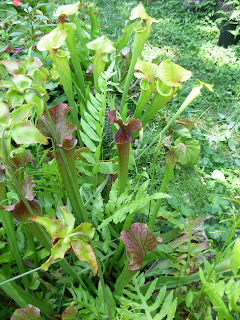
Another view of the front bed, dominated by the first Trachycarpus I ever planted (T. fortuneii). I have about a dozen species in various locations around the tiny property, and so far there's been no winter damage at all. This one is blooming for the first time this year, a mere 15 years after being planted.  Cyclamen purpurascens seedlings are blooming for the second year, having been sown four years back. You have to hunt for the blooms at this time of year, but it's always a neat surprise.
Below, more foliar combinations - Coleus "Inky Fingers", Amorphophallus konjac, and one of several pots of Caladiums I've stored dry in the attic for at least ten years. Can't imagine buying new ones every year.

 If I had to choose a favorite among the Hydrangeas, it would probably be the above, H. mariesii 'variegata'. I finally gave it a decent prune last year (having been shamed into it by a visiting friend,) and it's looking much better this year.
Cyclamen purpurascens seedlings are blooming for the second year, having been sown four years back. You have to hunt for the blooms at this time of year, but it's always a neat surprise.
Below, more foliar combinations - Coleus "Inky Fingers", Amorphophallus konjac, and one of several pots of Caladiums I've stored dry in the attic for at least ten years. Can't imagine buying new ones every year.

 If I had to choose a favorite among the Hydrangeas, it would probably be the above, H. mariesii 'variegata'. I finally gave it a decent prune last year (having been shamed into it by a visiting friend,) and it's looking much better this year.
 Below is a windowbox combo that I love - Begonia boliviensis, Kohleria 'Dark Velvet', and Achimenes 'Purple King'. Beneath the windowbox I placed some used dresser drawers, rescued from the curb one day ahead of the trash truck; I have no pride. I've found that these make great little raised bed planters, and in this one I've got some bamboo ferns that I raised from spores, more achimenes, Gloxinia nematanthodes, and Lysionotus sangzhiensis. More and more gesneriads are finding their way into the summer landscape here; I hope to expound on that at a later date; maybe during my next vacation...
 My grandmother's "Touch-Me-Nots", Impatiens balsamina, seed themselves through the back island bed with abandon. They make a great "good weed", filling up blank spaces, allowing for easy removal where they're not wanted, and bringing back happy childhood memories by providing fat, expoding pods to pick as I pass by with the pruners or watering can. Eupatorium coelestinum is another "escapee" which I edit out of the beds as need be.
I feel obligated to grow a few pots of this old variety of Caladium, "Postman Joyner", although, to my knowledge, no family member has ever worked as a mail carrier. I did have a great aunt who served as postmistress in her small Virginia town, but she was on my mother's side. A new Eucomis I picked up at a Whole Foods in North Carolina, of all places - it's a hybrid called "Twinkle Stars", and it looks great with a new Sinningia hybrid called "Bananas Foster". They're potted together, and should store through the winter in a cool, dry state just fine.
 Okay, it's not technically "growing" in the landscape, but then, a lot of my plants aren't; this is Phragmipedium "Sargeant Eric", cohabiting with Hedychium coronarium foliage for the summer. As much as I love the "hardy" Cypripediums, I have to admit that they really do require more "life support" in our temperate climate than do their subtropical cousins.

 More eucomis, in this case a couple of dozen "Sparkling Burgundy" plants interplanted with Sinningia selloviae; if the gesneriad bloomed a couple of weeks later, the display would be spectacular. It's one of the indeterminate species, so if I can remember to cut back the bloom stems, maybe we'll get another flush of blooms before the Eucomis inflorescenses fade completely. The Eucomis were all grown from leaf cuttings, and the Sinningias sprang from one pinch of dust-like seed received from a society seed exchange.
Back to the front bed for a closer look at Agapanthus "Ellamae", supposedly one of the best varieties for our area, and bearing that out after three years in this location. It descends from the species A. inapertus, which means that something about it doesn't open completely. I assume that refers to the individual blooms, which hang like blue bells from the head, but it could also refer to the rubbery, green bract that subtends the buds - I finally had to assist the buds of every umbel in escaping from its grasp.
 My neighbor is building this arbor beyond the fence that separates our properties, and it really improves our yard, too. Borrowed views are great, when they happen like that. These are but a few of the beautiful clumps whose names are lost in the recesses of my memory, but which we enjoy anyway. Wish there was room for many more; some are still in pots, which is not something they enjoy for extended periods of time.
 Keringeshoma coreana, a very cool perennial related to the Hydrangeas which I'm growing for the first time this year. K. palmata is similar, but the blooms don't open as widely (inapertus?)
 Another view of the variegated lacecap Hydrangea that I love...
  And a dark blue lacecap, originally a gift florist plant. It seems too dark to be "Blue Wave" - any ideas?
 It's just a Monarda (probably 'Adam'), but it looks like fireworks during July, and I like it.
 These cobalt berries form on the bloom scape of Dianella tasmanica, an Australian native that spends the winter in the unheated greenhouse. I may divide it next year and try part of it in the ground, if I can find a sunny, well-drained spot (always at a premium).
 The tropical Nymphaea "Panama Pacific" - it winters in the garage in an old aquarium and produces new plants in the leaf axils late in the season. These go in the inside aquaria, but not in the one housing the Herichthys severum, which find them delectable morsels for snacking.
 Another Hemerocallis (possibly "Femme de Joi"- every time Ron picks one out, it looks like this, so we have lots of short, apricot tetraploids) blooming with Salvia guaranitica 'Black and Blue', another gorgeous plant which is incredibly invasive if left to its own devices.
 Another great foliage combo - Arundo donax, the varigated form of the giant reed; Colocasia antiquorum 'illustris', with its toes in a temporary pond; and Arisaema consanguineum, my favorite species in terms of foliar impact.
My grandmother's "Touch-Me-Nots", Impatiens balsamina, seed themselves through the back island bed with abandon. They make a great "good weed", filling up blank spaces, allowing for easy removal where they're not wanted, and bringing back happy childhood memories by providing fat, expoding pods to pick as I pass by with the pruners or watering can. Eupatorium coelestinum is another "escapee" which I edit out of the beds as need be.
I feel obligated to grow a few pots of this old variety of Caladium, "Postman Joyner", although, to my knowledge, no family member has ever worked as a mail carrier. I did have a great aunt who served as postmistress in her small Virginia town, but she was on my mother's side.
 A new Eucomis I picked up at a Whole Foods in North Carolina, of all places - it's a hybrid called "Twinkle Stars", and it looks great with a new Sinningia hybrid called "Bananas Foster". They're potted together, and should store through the winter in a cool, dry state just fine.
 Okay, it's not technically "growing" in the landscape, but then, a lot of my plants aren't; this is Phragmipedium "Sargeant Eric", cohabiting with Hedychium coronarium foliage for the summer. As much as I love the "hardy" Cypripediums, I have to admit that they really do require more "life support" in our temperate climate than do their subtropical cousins.
 More eucomis, in this case a couple of dozen "Sparkling Burgundy" plants interplanted with Sinningia selloviae; if the gesneriad bloomed a couple of weeks later, the display would be spectacular. It's one of the indeterminate species, so if I can remember to cut back the bloom stems, maybe we'll get another flush of blooms before the Eucomis inflorescenses fade completely. The Eucomis were all grown from leaf cuttings, and the Sinningias sprang from one pinch of dust-like seed received from a society seed exchange.
Back to the front bed for a closer look at Agapanthus "Ellamae", supposedly one of the best varieties for our area, and bearing that out after three years in this location. It descends from the species A. inapertus, which means that something about it doesn't open completely. I assume that refers to the individual blooms, which hang like blue bells from the head, but it could also refer to the rubbery, green bract that subtends the buds - I finally had to assist the buds of every umbel in escaping from its grasp.
 My neighbor is building this arbor beyond the fence that separates our properties, and it really improves our yard, too. Borrowed views are great, when they happen like that. These are but a few of the beautiful clumps whose names are lost in the recesses of my memory, but which we enjoy anyway. Wish there was room for many more; some are still in pots, which is not something they enjoy for extended periods of time.Keringeshoma coreana, a very cool perennial related to the Hydrangeas which I'm growing for the first time this year. K. palmata is similar, but the blooms don't open as widely (inapertus?)
 Another view of the variegated lacecap Hydrangea that I love... And a dark blue lacecap, originally a gift florist plant. It seems too dark to be "Blue Wave" - any ideas?
 It's just a Monarda (probably 'Adam'), but it looks like fireworks during July, and I like it.
 These cobalt berries form on the bloom scape of Dianella tasmanica, an Australian native that spends the winter in the unheated greenhouse. I may divide it next year and try part of it in the ground, if I can find a sunny, well-drained spot (always at a premium).
 The tropical Nymphaea "Panama Pacific" - it winters in the garage in an old aquarium and produces new plants in the leaf axils late in the season. These go in the inside aquaria, but not in the one housing the Herichthys severum, which find them delectable morsels for snacking.
 Another Hemerocallis (possibly "Femme de Joi"- every time Ron picks one out, it looks like this, so we have lots of short, apricot tetraploids) blooming with Salvia guaranitica 'Black and Blue', another gorgeous plant which is incredibly invasive if left to its own devices.
 Another great foliage combo - Arundo donax, the varigated form of the giant reed; Colocasia antiquorum 'illustris', with its toes in a temporary pond; and Arisaema consanguineum, my favorite species in terms of foliar impact.
More Sarracenias, this time S. leucantha, filtering the sunlight through the white fenestrations that decorate each tube and exist to confuse insects which are unliucky enough to find themselves marooned on the inside.


Back to the rear island bed, with foliage colors and textures repeating and contrasing in beautiful patterns. Wish I could say that I planned all of this.

Finally, a little (very little) garden "art" - a fake boat headed into one of the ponds with a cargo of Lysimachia, surrounded by more Tetrapanax, Cannas, Hydrangea "Endless Summer", and Colocasias. In the foreground is Crinum eboracea, a hybrid of C. bulbispermum and C. asiaticum. I know this "tropicalismo" style of garden is a big, fat, fake, but I have to admit that I really enjoy the look of the garden at this time of year. It would probably be more politically correct to have given over all of this space to vegetables this year, and we do have our big pots of grape tomatoes, basil, etc., just as always. I have to admit to being somewhat amused by all of the professional garden writers who are just now learning to grow food, since I grew up in the vegetable garden with my parents and grandparents, and have always just assumed that everyone genetically knew how. However, until I'm unable to afford my visits to the local farmers' market, our quarter acre of land in its midsummer glory is too precious to be turned into a truck farm.
One question unrelated to gardening: can anyone offer advice concerning placing and moving pictures within these posts? One reason I don't post more often is that this is such an unwieldy process. For instance, the first two pictures in this post were afterthoughts, but are stuck on at the beginning because I was unable to move them to other locations. Also, every time I add a picture, spaces appear throughout the post, each of which has to be manually eliminated before the post can be published. There must be a trick here that I don't know about, and I'd be grateful for any assistance! Happy summer, everyone!
 Happy summer, everyone!


 Chaenomeles japonica, another remnant of my grandparents' garden, and badly in need of thinning and pruning.


 I used a tool called a wire puller, a flexible wire coil which opens its "arms" when pressure is applied on the handle,
 and a tool I made from a teaspoon, some electrical tape, and a bamboo stake (which had to be reinforced along its length by three heavy-guage wire insulation holders after breaking in the middle of the procedure).
  I started out very carefully, trying hard to lock the pincers of the wire puller around the crowns of each plant, reverse its polarity, shake off the soil, and pull it gently through the neck of the Florence flask. After about 10 minutes of cursing which would have made Tony Soprano blush, I gave up and started getting Medieval on the mass of vegetation. When everything was extracted, I ended up with the following:
 9 pots of Begonia 'Buttercup' rhizomes in various stages of growth, but which I feel will produce beautiful plants in a few months. This is a hybrid involving B. prismatocarpa, an African species which requires lots of warmth and humidity to do well, but produces occasional bright yellow blooms. From the enormous pile of severed leaves I prepared about a dozen leaf cuttings as well (why? - there's no place to grow them here at all, and they're not hardy, which is the kiss of death at a plant sale around here...). These are under a humidity dome on a heat mat below a bank of fluorescent lights in the garage right now (how many prepositions can you use in a sentence?)


